
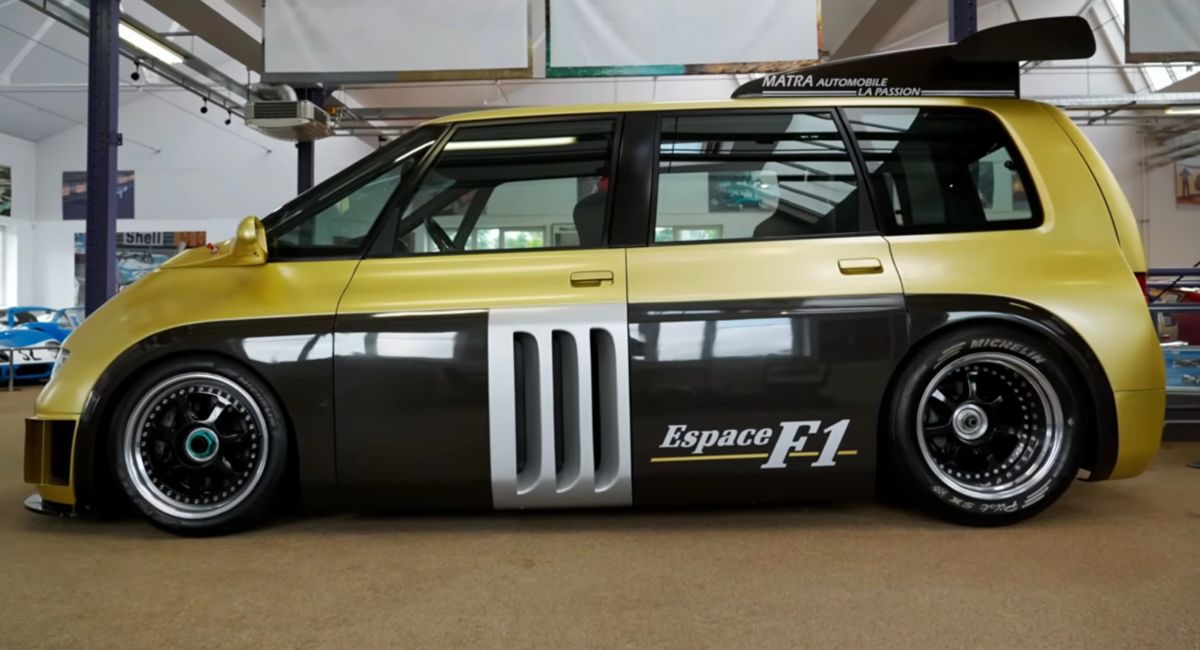
In 1994, Renault decided that a perfectly sensible family minivan needed an 800-horsepower Formula One engine.
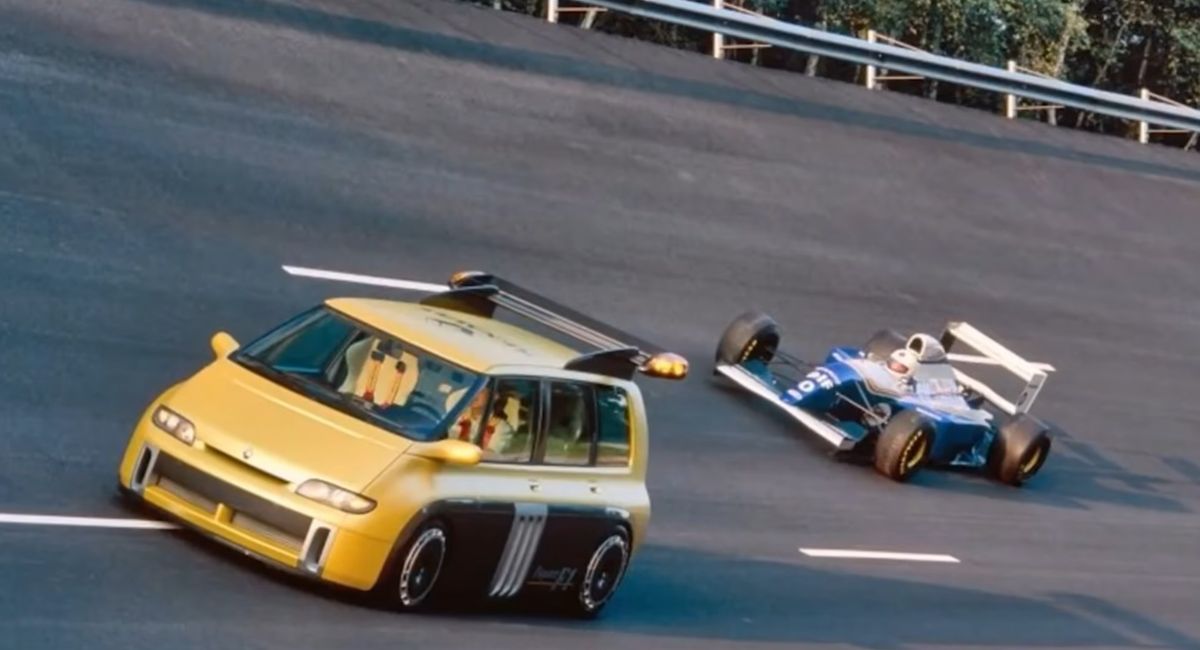
The result was a gold-painted, carbon-fiber monster with four racing seats, a gigantic rear wing, and a V10 capable of screaming beyond 13,000 rpm.
It could reach 100 km/h (62 mph) in 2.8 seconds and had enough power to embarrass some of the world’s most expensive supercars.
How a Sensible Family Car Became Completely Unhinged
The original Renault Espace arrived in 1984 and helped establish the modern European multi-purpose vehicle.
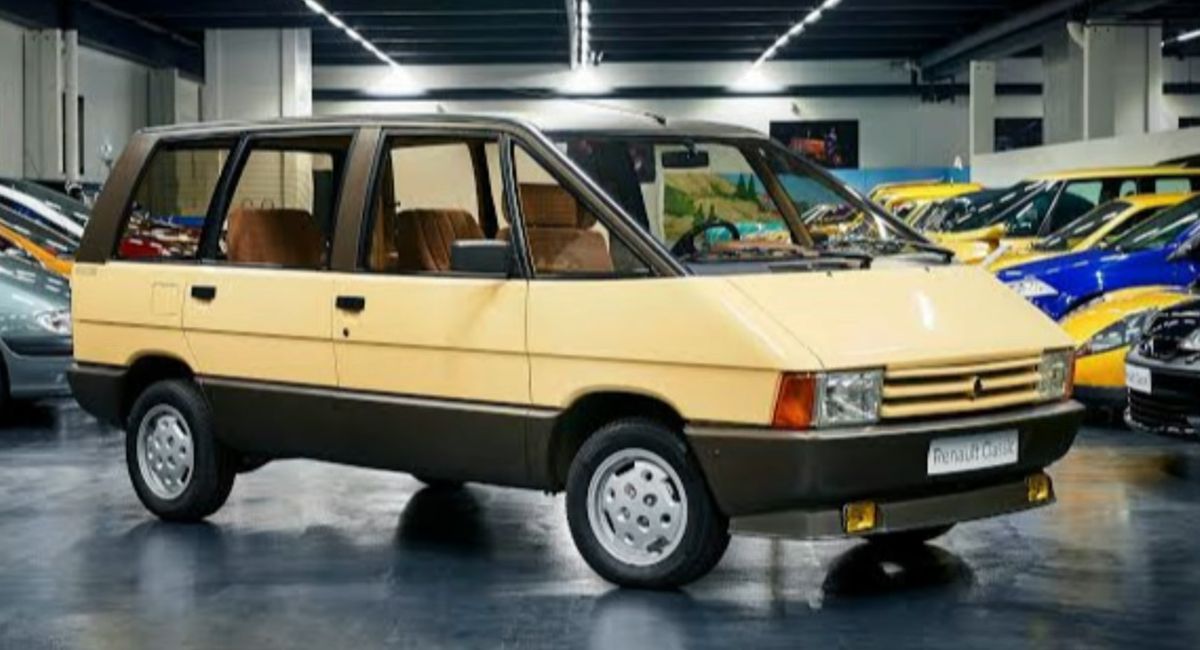
Its development was already an unusual story. Matra, the French engineering company behind the project, had previously approached Peugeot and Citroën with versions of its family-car concept. Both manufacturers rejected the idea.
Renault recognized the potential and agreed to bring the Espace to market, with Matra handling production.
It was a gamble that paid off. The spacious, adaptable Espace became an important part of Renault’s lineup, and by the early 1990s, the second-generation model had established a strong reputation as a capable family vehicle.
Meanwhile, Renault’s Formula One program was enjoying extraordinary success.
The company’s V10 engines powered Williams to three consecutive Constructors’ Championships between 1992 and 1994. Nigel Mansell won the drivers’ title in 1992, followed by Alain Prost in 1993.
Two very different Renault success stories were happening simultaneously.
For the Espace’s tenth anniversary, Renault and Matra decided to combine them.
The resulting project was one of the greatest examples of engineers being handed an outrageous idea and receiving permission to make it happen.
A Championship-Winning V10 in a Minivan
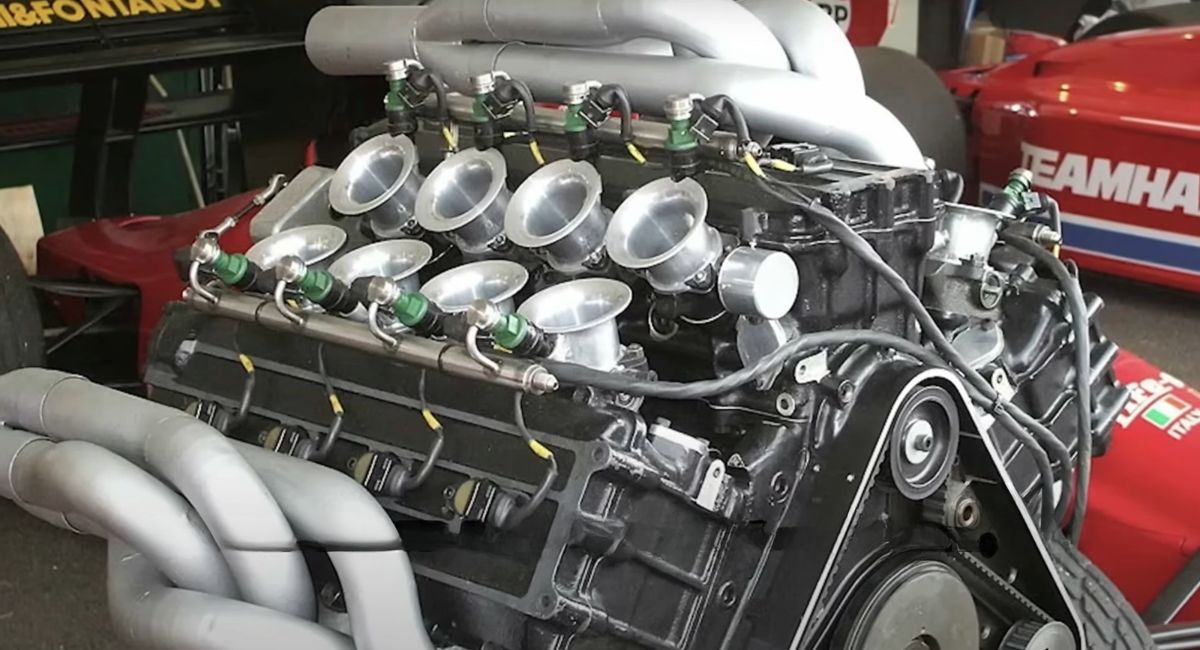
The mechanical centerpiece was a naturally aspirated 3.5-liter Renault RS5 V10, closely related to the engine that powered Alain Prost’s championship-winning Williams FW15C in 1993.
According to Renault’s own historical documentation, the engine developed approximately 800 horsepower.
That figure deserves some perspective.
A contemporary Ferrari F40 produced 478 horsepower. The Lamborghini Diablo VT developed around 492 horsepower. Even the McLaren F1, one of the most extraordinary road cars of its generation, produced 627 horsepower.
Renault had somehow given its family minivan substantially more power than all three.
And the mechanical modifications went considerably further than the engine.
The Espace F1 used a specially constructed carbon-fiber chassis with aluminum honeycomb reinforcement. Formula One-derived rear suspension hardware and a six-speed semi-automatic gearbox sent power to the rear wheels.
Carbon racing brakes provided the stopping power, while Michelin tires helped transfer the engine’s enormous output to the asphalt.
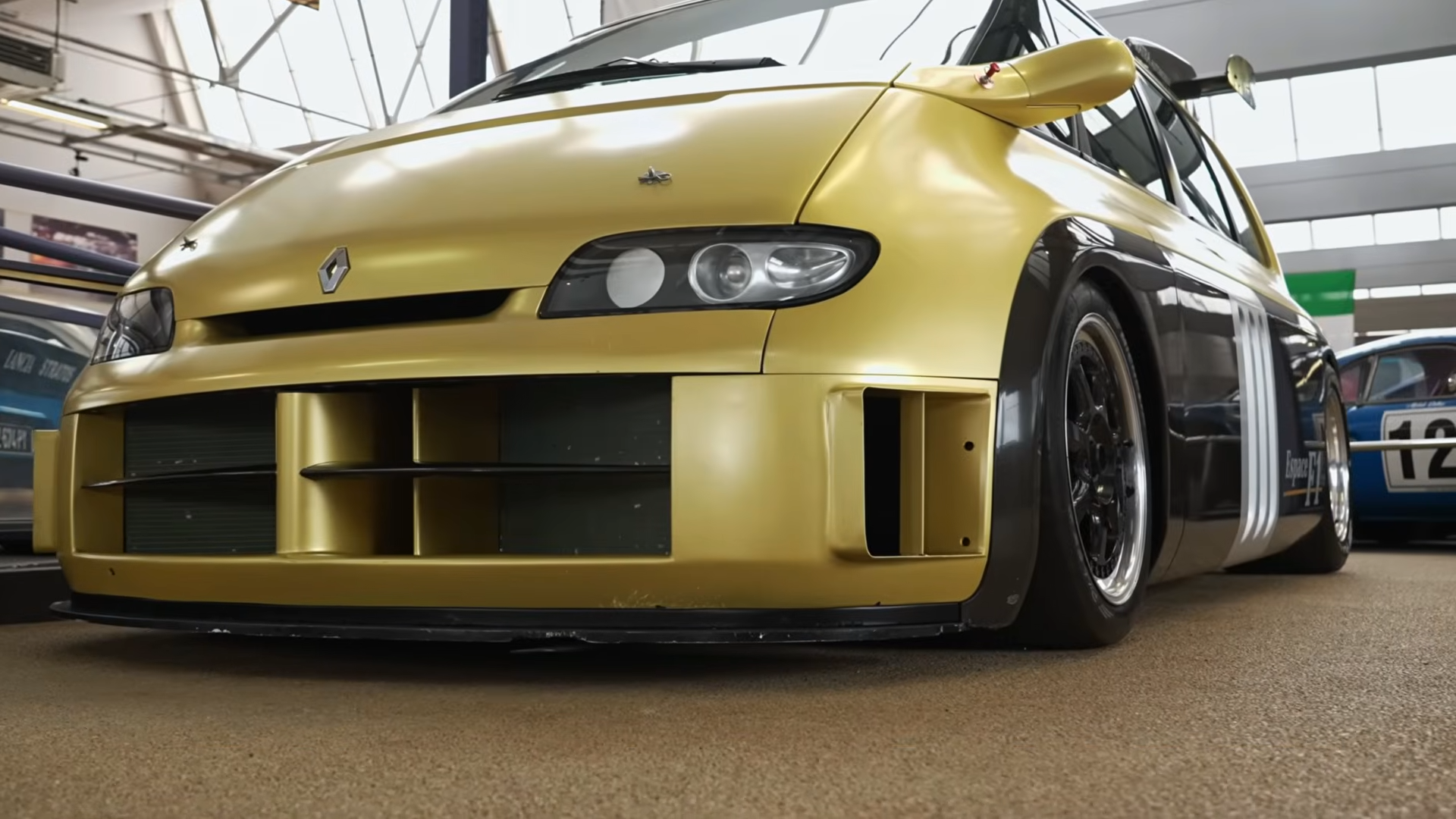
The familiar Espace silhouette survived, although the body was dramatically widened and equipped with large cooling openings, aggressive aerodynamic elements, and an enormous roof-mounted rear wing.
It looked like somebody had instructed an aerodynamicist to turn a children’s school bus into a Le Mans prototype.
We absolutely love it.
The Renault Espace F1: Numbers That Still Look Ridiculous
Think about that acceleration figure for a moment.
Its performance figures remain outrageous even by modern standards.
Four Seats and a V10 for Company
Step inside the Espace F1, and the engineering lunacy becomes even more obvious.
The spacious interior of the production model had been transformed into a compact racing cockpit.
Four individual carbon-fiber bucket seats replaced the Espace’s conventional seating arrangement. Each occupant received a proper racing harness, and the cabin featured extensive structural reinforcement.
The giant V10 occupied the middle of the vehicle, between the rear seats.
Imagine sitting in the back of a family minivan with a Formula One engine running inches away.
At full throttle, that engine could rev beyond 13,000 rpm, producing the unmistakable high-pitched scream that defined Formula One’s naturally aspirated era.
Modern performance cars spend considerable engineering effort generating exciting artificial engine sounds through speakers. The Espace F1 had ten cylinders delivering the real thing directly into the passenger compartment.
We struggle to think of a more spectacularly inappropriate environment for a racing engine.
And that’s exactly why the car is so wonderful.
Alain Prost Actually Drove This Thing
The Renault Espace F1 made its public debut at the Paris Motor Show in October 1994.
It immediately became one of the event’s most extraordinary exhibits, offering an almost comical combination of everyday bodywork and championship-level racing engineering.
Yet the project had another surprise.
Prost, the four-time world champion who had driven Renault-powered Williams machinery to the 1993 title, was perfectly qualified to appreciate the bizarre transformation.
The sight of an Espace attacking a racing circuit, accompanied by the unmistakable scream of a Formula One V10, must have been astonishing.
Watch the remarkable Renault Espace F1 in action and discover how Renault transformed a family minivan into an 800-horsepower Formula One-powered machine.
The vehicle even performed safety-car duties during some circuit events, according to Renault’s heritage archive.
Contemporary journalists were equally fascinated.
In a retrospective account of its 1995 passenger experience, Autocar described the extraordinary machine, including its carbon-fiber construction and ferocious acceleration.
A vehicle with the proportions of a family carrier was suddenly capable of delivering a genuine Formula One-inspired passenger experience.
That’s the sort of engineering madness that deserves its own museum wing.
Renault Built Two Examples
One detail frequently disappears from retellings of the Espace F1 story.
Renault’s historical records confirm that two examples were produced.
One was the operational prototype used for track demonstrations, while the other was a static display model.
The running car became part of the Matra museum collection in Romorantin-Lanthenay, France. The second example entered Renault’s heritage collection.
Neither was intended for production, and the idea of a road-going 800-horsepower Espace never progressed beyond the experimental project.
That was probably a sensible decision from a manufacturing and commercial perspective.
Still, we would happily trade a considerable number of forgettable anniversary editions for another vehicle this spectacular.
The Espace F1 Was Renault at Its Most Fearless
The Espace F1 represents an era when manufacturers occasionally allowed their engineering departments to pursue ideas that were completely outrageous.
Its purpose was promotional. Renault wanted to celebrate its successful partnership with Matra and draw attention to its Formula One achievements.
The engineers responded with one of the wildest demonstration vehicles ever assembled.
And it worked brilliantly.
People continue talking about the Espace F1 more than three decades after its debut. The bizarre proportions, spectacular engine, outrageous performance, and sheer audacity have given it a permanent place in automotive culture.
There is a certain family resemblance in spirit to another racing oddity we’ve covered, the Ferrari 250 GT SWB Breadvan. Both proved that extraordinary racing machinery could emerge from deeply unconventional ideas about what a fast car should look like.
We firmly believe the Espace F1 ranks among Renault’s greatest creations.
It demonstrated technical ability, celebrated an extraordinary period of motorsport success, and created something enthusiasts would remember for generations.